Pages

Showing posts with label technology. Show all posts

Friday, August 21, 2026

Things that deserve more stink eye?

Um, this was a surprise. Hmm...is it just a coincidence or is this some sort of (cryptic) response to my recent post (beef) about WORDLE?

Um, you know when you've been joking (shit-talking) about the Internet (wasteland) and sharing your totally unserious (serious) feelings about sentient (consciously malicious) technology and (hostile) AI and the INEVITABLE SINGULARITY SPONSORED BY BILLIONAIRES (the greed-based ongoing decline toward a hell-scape dystopia whereby us regular folks are enslaved by our phones/ technology in service to corrupt influencers and unrestrained plutocrats aka META et al).... Well c'mon Internet (LORD OF THE PINGS), all I did was challenge WORDLE to a battle of wits!

So, am I officially frenemies with WORDLE? Or is this a white flag? Or is this a threat disguised as a white flag? (Spoiler: YES IT IS.) Now that they've destabilized me, who knows what this means, and what's next?!

Sunday, February 4, 2018

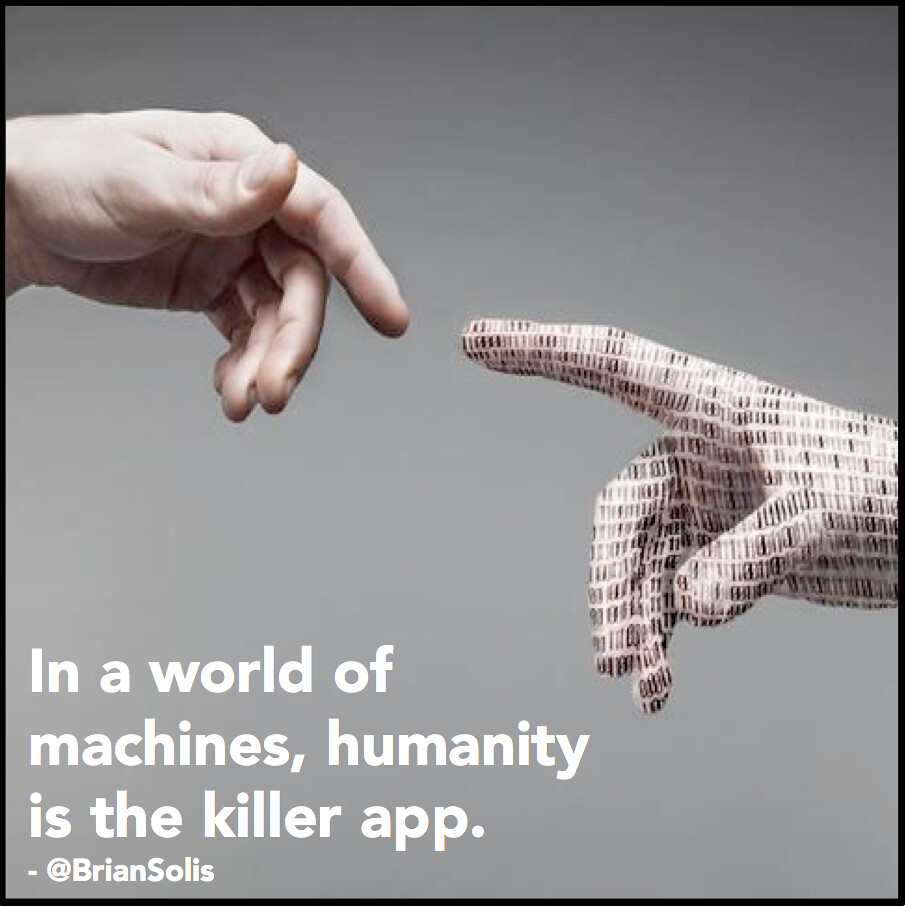
Being_Human?

Source, no changes
I tend to think in stories and the best ones inhabit me, so as I learn more about the digital humanities—like the fish gaining heightened awareness about the water in which he swims—one story resonates. In “Men areDifferent,” Alan Bloch (1963) writes about a robot archeologist—an android indistinguishable from humans—who tells about the shared history of robots and humans and then describes his trip to a faraway planet where he encountered a man, the last one in the universe. This lonely man “had forgotten how to talk” but with time, the robot and the man learned to communicate. One day the man complained of heat so the robot, inferring that the man’s thermostats were faulty, turned him off by piercing his neck—the same method used to switch off a robot—but alas, he could not get him “running” again. Soon this last man weathered away to bones. A classic science fiction foreboding, elements in Bloch’s tale align with my expanding knowledge and experience of the digital humanities and, as an educator, studying this field awakens within me an urgency for ongoing education, new literacies, and collaboration to foster a more humanistic future for our society. As MIT Scholars Burdick, et al, (2012) ask, what does it mean to be a human being in the networked information age? (p. vii). We had better find out.

Although written in the 1960s, Bloch’s story echoes our current digital reality. Almost everyone on Earth (myself included) is in what feels like an benign relationship with a smart device, yet the power dynamics are not reciprocal. For example, corporations like Facebook use us puppet-like as “unpaid labour” (Berry & Fagerjord, 2017, p. 16) as they mine our online practices for consumer trends and patterns. Each ‘like’ is data for them and dopamine for us. How did we end up here? Technology and virtual reality pioneer Jaron Lanier (2011) cautions, “[i]t is time to take stock” (p. 19), time to expose the ways technological tools have evolved (or not) and critically examine their effects on crowd behaviours, finance, research, culture, even spirituality: “the deep meaning of personhood is being reduced by illusions of bits” (Lanier, p. 19-20). Technology is accelerating rapid social change in how we shop, engage with text, communicate, even fall in love. Amidst the knowledge and skills required to navigate this rapid change and their underlying mechanisms, how do we reinforce humanistic pursuits?

Taking stock means assessing our current situation, getting educated, and acting on it in ways that advance epistemology, reasoning, and practices. Although Bloch’s story fancies that technological determinism—powered by artificial intelligence toward a dangerous endgame—is inevitable, our global society can still influence and positively alter our future if we embrace means and methods that seek to enlighten our technological paths and the information it produces. We can continue to simply consume slick technology for convenience, escapism, trolling—whatever ‘feels’ we seek—or we can use these tools to enable an alternative: “we have to think about the digital layers we are laying down now in order to benefit future generations” and address important issues including “global warming… new energy … wars… aging populations …basic business” (Lanier, 2011, p. 36). There is much to understand about the digital underpinnings at play in our technology; Humanities-based literacies will play a significant role worldwide. Burdick, et al (2012), propose that “Digital humanities may well function as a core curriculum for the 21st century” (p. 5), one where we join forces as global stakeholders in advancing fundamental human rights and values. This is critical given our current environment. With something as simple as basic digital citizenship we have leaders tweeting about the size of their nuclear buttons. 

In Bloch’s story the robot-archaeologist acts as an historian yet his worldview is dangerously one-sided. By nature, archeology requires digging. Digital humanities provide a means to ‘dig’ into Lanier’s “layers” and “structures” inherent in both the sciences and the humanities. Rosenbloom (2012) highlights a need for “a form of methodological pluralism in which multiple methods may be necessary to increase our understanding of individual domains” (p. 223). This requires a new collaboration between the humanities and the sciences, a return to a basic founding principle of the digital Information Age: “[the Internet itself] provided a new model of how people could communicate with each other, [and] changed the nature of collaboration” (Lenier, et al, 1997, p. 7). Digital Humanities scholars, Berry & Fagerjord (2017) also emphasize renewed and new forms of collaboration to facilitate “both the ‘hack’ aspect of knowing how to use computers in humanities scholarship, and the ‘yack’ aspect of knowing how to think about what it is we are doing” (p. 1). Lanier (2010) likewise illustrates the associated negative outcomes of a lack of collective, thoughtful reflection on how to use technology nobly: “I fear we are beginning to design ourselves to suit digital models of us, and I worry about a leaching of empathy and humanity in the process” (p. 39).

Bloch’s robot-archeologist, certainly lacked the necessary empathy and humanity, thus the tragic outcome. The story evokes the discord between “machine” and mankind, what Rosenbloom (2012) refers to as the “uneasy relationship between science and the humanities” (p. 220). If Bloch’s robot represents science, and pathos for the last man represents the absence of humanities, Bloch’s climax implies that we must better understand our technological tools and their impact or, through ignorance and entropy, aid our downfall. It is necessary to infuse a humanistic worldview in our approach to technology or like the fate of Bloch’s last man see our values “weather away.” But how? Through education and new literacies that combine the sciences and the humanities and through shared goals. Without it, we will remain like intellectuals feasting at a dinner party, armed with only perfunctory knowledge about our food’s origins and thus continue take our feast for granted.

In Bloch’s story the robot and the man had to learn to communicate with each other. Assuming mankind created the robot, how did they lose a common language? At some historical point, one might hypothesize they evolved to form differing networks. Using his treatise on our networked society in the Information Age, Castells (2000) might also propose that one network had switched off another it deemed no-longer compatible (p. 22). Castells (2000) notes that “there is little chance of social change within a given network” (p. 22) except “to challenge the network from the outside and in fact destroy it by building an alternative network around alternative values” (p. 16). Indeed. This is key to our current story too. If we develop an alternative network founded on technical literacy combined with humanities principles—such as wisdom, philosophy, reasoning—we can foster a new discourse, one founded in critical thinking intent on using powerful technological tools for greater social stewardship: “Digital_Humanities…envisages the present era as one of exceptional promise for the renewal of humanistic scholarship and sets out to demonstrate the contributions of contemporary humanities scholarship to new modes of knowledge formation enabled by networked, digital environments.” (Burdick, et al, 2012, p. 7).

Like Bloch’s story reveals, there is a current need to reflect on unequal power dynamics and expose/examine the “switchers or power-holders in our society (…connections between media and politics, financial markets and technology, science and the military, and drug traffic and global finance through money laundering)” (Castells, 2000, p. 16). In doing so, we can expose this “human-made automaton” (Castells, 2000, p. 17) global network currently shaping our society rather than the other way around. As Lanier (2010) states, “someone who has been immersed in [our current] orthodoxy [like a fish unaware of the water] needs to experience a figure-ground reversal in order to gain perspective” (p. 23). I am most interested in Lanier’s (2010) “alternative mental environment” (p. 26), with diverse perspectives not composed of a mass of “people who are no longer acting like individuals” (p. xiii). Digital humanities provide new ways to reflect on technology, media, text, research, our values, our future. As an educator dedicated to advancing learning, I recognize at the core of Bloch’s story the breakdown that enables a technological dystopia: ignorance, sustained by apathy or exploited by greed. I doubt Bloch’s notion of our bleak future; however, without education and new literacies—without the combined ‘hack’ and ‘yack,’ we may not even recognize what is human, if we are all thinking like Bloch’s robot. 

References
Berry, D. & Fagerjord, A. (2017) On the way to computational thinking. In Digital Humanities: Knowledge and Critique in a Digital Age. Malden, MA: Polity. 1, 16.

Bloch, A. (1963). Men are Different. In Fifty Short Science Fiction Tales. Asimov, I. & Conklin, G. (Eds.) Collier Books. USA. Retrieved from http://www.gdhsenglish.com/thompson/assets/pdfs/ENG3U1%20pdf's/Short%20Stories/Men%20Are%20Different.pdf

Burdick, A., Drucker, J., Lunenfeld, P., Presner, T. & Schnapp, J. (2012). Digital_Humanities. Massachusetts Institute of Technology. MIT Press. Cambridge, MA. vii, 5, 7.

Castells, M. (2000). Materials for an exploratory theory of the network society. British Journal of Sociology. Vol. No. 51 Issue No. 1. London School of Economics 2000. 16, 17, 22.

Lanier, J. (2010). You are not a Gadget. Vintage Books. New York, NY. xiii, 19-20, 23, 26, 36, 39.

Lenier, B.M., et al. (1997). Brief History of the Internet. Internet Society. 7. Retrieved from https://www.internetsociety.org/internet/history-internet/brief-history-internet/

Rosenbloom, P. (2012). Toward a Conceptual Framework for the Digital Humanities. In Digitial Humanities Quarterly, 6 (2). 220, 223. Retrieved from http://ict.usc.edu/pubs/Towards%20a%20Conceptual%20Framework%20for%20Digital%20Humanities.pdf

Wednesday, January 27, 2016

Marshmallow test?

I hesitate to call it an oven mitt. Sure, it's an 'ove' glove but I prefer HULK HAND. A gift from my wife, instead of hulk anger it incites in me this desire to test it on really, REALLY hot things. Casseroles? No problem. Lava? ABSOLUTELY. And that's why I foresee a sad end for this asbestos-packed kitchen wonder-mitt. In other words, I suspect that around the campfire this summer, the marshmallow test will have a whole new meaning, and no stick required! That's reasonable, right?

Monday, June 15, 2015

Things that deserve the stink-eye:

Dear Google Hangout,

Yes. I'm still here. But I must admit, this prompt was a little unnerving. Why so existential Google? Are you watching me?

Signed,
Someone who wonders sometimes if science fiction isn't so fiction-y anymore.

Friday, March 20, 2015

Remember Day

Do you recall
1.      When we all had VCRs?
2.      And the clock forever flashed?
3.      And “be kind rewind?”
4.      And remember fondue parties?
5.      And when phones were attached to the wall?
6.      Remember phone booths?
7.      And when we had a lock combination to memorize instead of twenty passwords?
8.      And we carried cash? And there were dollar bills?
9.      And we opened car windows with handles? And we opened car doors for women?
10.  And remember before air conditioning?
11.  Remember when cats weren’t famous on the Internet?
12.  Remember when it was A cloud and not THE cloud?
13.  Remember that noise fax machines made? Ditto dial-up internet?
14.  And lots of people wore shirts that said Bum Equipment or Just do it or Vote for Pedro?
15.  Remember Y2K?
16.  Remember when we didn't feel nervous being in an airport? And we didn't have to arrive three hours in advance? And bottled water wasn't an apparent weapon?
17.  Remember YOLO?
18.  Remember beanie-babies?
19.  And Polaroid cameras?
20.  Remember reading Harry Potter that first time?
21.  Remember playing outside?
22.  Remember climbing trees?
23.  Remember waiting for an hour in a car waiting for your parents to return?
24.  Remember buying cigarettes for your Dad?
25.  Remember when our parents were young? Our brothers? Our sisters? Our children? Remember when we were young?

Science say remembering one thing versus another is a by-product of reinforcement. One particularly effective memory reinforcer is emotion. In other words, if you felt it deeply, you’ll likely never forget it. These feelings may fade but they remain. Sometimes I think there should be a day just for remembering, a remembering day. Why not today? 

Friday, October 10, 2014

"Is it, question mark?"

Walking down the street the other day, I was chatting with my cell phone when I looked up to discover some people with quizzical looks. But everyone does this, right?

Several times each day, I talk to my phone. For a writer, for any sort of creative, for anyone hoping to remember something, this is ideal. Thinking is productive. Thinking aloud is even more productive when those thoughts can be captured. That’s why I’ve trained my phone (or maybe it’s trained me?) to listen while I share my ideas and think aloud. I’ve programmed it to record, type and even repeat back to me what I’ve said. While driving, while walking, while at work, my phone is required to listen to me and take notes.

Mostly, I record this information privately. But then I forgot. And some boundaries became blurred. The tipping point occurred recently when I was in the midst of a real-life, in person, conversation with someone and this happened:

Me: “What do you mean, question mark?”
The other person: “What?”
Me: “Um, (clearing my throat) what do you mean?”

You see, when I speak to my phone it will even record my preferred punctuation so when I want it to record a question I end said question with “question mark.”

I should probably get out more.

It's probably true. My iPhone might own me. But I’m not like all those others; I’m not obsessed. Maybe you’ve heard of “nomophobia” (fear of no mobile phone)? That’s not me, is it, question mark?

Hmm. Maybe the saying is true: “life was much simpler when apple was just a fruit.”

Monday, April 15, 2013

Which was more?

These stones, manufactured to protect the Castel Sant'Angelo in Rome, are stacked in a pile not far from St. Michael, sculpted by an assistant to Michelangelo, believed to be the spiritual warrior, a symbol of the inner struggle to combat evil, the "battle within."

I had to admire these stones. A fan of historical warfare, I sometimes marvel at the ways men of ancient times fought like boys, quite similar really to the way my boyhood cousins and I would play rock wars and use sling shots like catapults while we hid in groups behind piles of construction gravel along the roadways near our homes.

I remember flinging rocks. Fondly.

Please don't misunderstand me though. I know it is inappropriate to romanticize war in any way, yet when I consider modern warfare and weaponry by comparison...it sickens me. Especially today, another day swallowed up with senseless terrorism. And it makes me wonder: then or now--which was more barbaric?

Thursday, October 25, 2012

Things that deserve the stink-eye:


After several years of marriage things change. Things evolve. Attention shifts. Priorities get, uh, reprioritized. Eventually, some wives simply replace their husbands. Sometimes this happens without much warning. Sometimes the guy doesn’t even know. Sometimes maybe a guy doesn’t even notice because he still lives in the house with his wife.  At least not at first. And then one day he has an inkling...that something is different. And then a month passes and he has another inkling and then he’s sure, something has definitely changed. It happens. And now it’s happened to me. My wife replaced me. And here’s the skinny on my wife’s new husband:
      1.      He’s skinny.
2.      Sleek even.
3.      Attractive.
4.      Intelligent.
5.      Convenient.
6.      Hardly has any needs.
7.      Is easy to manipulate.
8.      He communicates in multiple ways.
9.      Is popular and can do way awesome stuff.
10.  Doesn’t care about the remote control.
11.  Doesn’t eat her food.
12.  He’s touchy-feely.
13.  He’s interactive.
14.  He does whatever she wants.
15.  Encourages her to shop.
16.  Everyone gathers around when he’s in the room.
17.  He’s so fantastic, my wife’s friends are jealous.
18.  Even my friends think he’s several levels cooler than I am.
19.  He goes “ding” just to mock me.
20. And just this morning, my wife looked at me all dreamy and said, "I'm in love with my iPad."

Thursday, March 15, 2012

I miss when...

Source.
I still knew people who sported pocket protectors.

#imissrevengeofthenerds
#theyshouldmakepocketprotectorsforcellphones
#omgtheydo

Friday, March 2, 2012

I want an accordion.


Image from here.
I know we’re well into it now but I’ve only really just discovered something about the 21st century.

It sounds different. Significantly different.

And I’m not talking about the accordion from the 70s that never ever shows up at parties anymore. (Wouldn’t it be cool if it did?! Just imagine someone pulling out an accordion and lettin’ her rip. I’m 96% sure everyone would freak out in a good way. And then it would be on Youtube and there would be like nine million hits and then BAM somebody’s on a talk show. Whoa. No one steal this idea. Seriously. If only I had an accordion.... Okay I’m back from kijiji. Accordions are expensive. And I’m cheap. Let’s just say that if someone had an old accordion hoarded in their basement and if that someone were to anonymously leave said musty accordion outside my back door I would not turn up my nose at your shenanigans and if you also left me a bag of chocolate chips I would lovingly dedicate my first talk show accordion performance to you and only you.)

Anyway, back to my scheduled topic: what does the 21st century sound like?

Mmmmmmmup. Mmmmmmmmp. Mmmmmmmp.

Come on reader. You know what this is. The first time it woke me up in my bedroom one early morn I visualized a tiny kidnap victim, his mouth duct-taped shut, hidden somewhere deep in my clothes basket. But it doesn’t always sound that way. Sometimes I hear an 80s tune. Sometimes there are quacks.

There are now four cell phones buzzing and beeping and distracting me in my home every day. And even when they are supposedly asleep, I sometimes hear their Mmmmmmp and I recall the frogs croaking outside my childhood window and I wonder are these phones sending messages to each other. Yeah I know: duh. What I meant is that perhaps these phones are communicating with each other in ways unbeknownst to us. Suspicious ways. Sometimes I come into the room and I swear I just heard one of them Mmmmmmp but guess what? Silence.

Think. About. That.

I guess I just long for the past. An uncomplicated less paranoid past. A past when people played accordions. A past like this: “The bathtub was invented in 1850 and the telephone in 1875. In other words, if you had been living in 1850, you could have sat in the bathtub for 25 years without having to answer the phone.” -Bill DeWitt 

That silence sounds great to me.

Thursday, February 2, 2012

Dear Fellow Shopper,

Evil.
I was attempting not to make eye contact with anyone at the shopping cart corral in the grocery store parking lot today but when you noticed that I seemed unable to even begin to fathom how to use the insert coin and do something with the chain thingamawhatinthehellisgoingon doodad system to obtain a shopping cart, I would have preferred that you offered me some assistance instead of smirking and then rushing back to your car to text your girlfriends that some husband using the grocery store for the first time couldn't get a cart because he's a total knob (and stop judging me okay because I'm not the usual grocery store shopper in my family and I never go to stores with carts manufactured by the devil without my wife so she always does this part and indeed I've never admitted to her that I am incapable of using this insert coin and do something with the chain thingamawhatinthehellisgoingon doodad system) meanwhile I tried to yank that cart off the chain (creating a series of ripple effects and aftershocks heard by shoppers everywhere instinctively reaching down to turn their children's eyes away from the nutbar going ape on the shopping carts) instead of admit I'm a feckless twit to the 14 year old cart boy playing runaway train all over the parking lot so of course I did NOT ask for help even when it wouldn't spit my money back out and thus I finally gave up, stomped into the grocery store and began juggling oranges, apples, a jalapeno pepper, bananas, onions, asparagus, three boxes of greek yogurt, a container of lemon juice, an aero bar and some tic-tacs down aisle after aisle until I finally gave the cashier at that store my money and let's be honest, a good laugh when the staff reviews the video surveillance tapes at a future staff party like we all know they do.

Signed,
The Guy who lost his $1 coin and his Dignity today at the Grocery Store

Saturday, April 30, 2011

Battle Preparations

Scottish warrior William Wallace.
Kinda.
Yeah. So. I phoned the phone company.

I had one message: LOWER MY DAMN BILL. I mean, come on phone companies: stop plundering!

Before I called I did some stretches. Paced a bit. Cracked an ice tray into a very large mug. Added scotch water. A little lemon. Did some cleansing breaths. Prepared to be on hold for 53 minutes. Yawned to open my ears so I'd be better able to decipher the foreign accent. (Hey. Don't judge me. I hate racism. It's called outsourcing.) Painted three-quarters of my face blue. Hunkered down, prepared for battle. Dialed. *cue James Horner film score*

Pressed 1. Pressed 5. Pressed 2. Hold. One minute passes. (One minute?!) "Hi this is Sarah, how may I help you?" (Perfect language skills?!)

(in Scottish accent) You tell your king that William Wallace will not be ruled, nor will any Scot YOU BASTARDS!!! "Hi Sarah. I've been a customer for many years. We no longer use our land-line phone the way we once did. I'm wondering what you could offer me that would lower my bill."

"Certainly sir. Let me see...(less than five minutes later)...so your new package should cut your bill by almost 30% and by upgrading your internet package at no extra charge your browsing speed should improve. Is there anything else I can help you with?"

[insert sound effect here]

"Uh. No. Thanks so much."

Later, unable to process the entirely unexpected anticlimactic nature of this experience compounded by all the bottled-up energy for the war I did not have to fight, I was forced to punch myself in the eye repeatedly because I obviously should have phoned months ago. Fuck.

Friday, April 29, 2011

Survey Says?

I saw this survey online. Which would you give up first?
a. Cell phone
b. TV
c. Spouse

It made me laugh. And then it made me think. How many people would choose cell phone? Honestly. How many people?

About four years ago now, major newspapers reported that there was one cell phone for every two people in the world. Imagine how many exist now.

This is not a post intended to complain about cell phones. That would make me a hypocrite. Although I don’t have a cell phone I would be extremely reluctant to give up my iPod. Or most definitely my laptop. How would I continue to email? Tweet? Blog? Shop online? I can’t imagine my life without these.

That’s odd though isn’t it? I can’t imagine my life without these various forms of technology and the luxuries they provide? When I let that process for a minute it makes me shake my head. Why?

Because actually, if I’m really honest, I can’t imagine my life without my family, my friends, ice cream, books, salsa, falling asleep on the couch, art, music, laughing, nature, my home, carpenters, plumbers, root beer, frogs croaking at night when it’s finally finally Spring and that’s just what I experienced in the last few hours. There’s so much more too.

It reminds me of this key question: “is the glass half empty, half full, or twice as large as it needs to be?” 

Thursday, March 31, 2011

Wordfuse (Political Edition)

A new version of the iGovernment is available now.
Would you like to download it (even though it's pointless)?
o download iGovernment        o WTF?   
We Canadians are having yet another election, our third in five years. *shakes head* Our current government seems to be prompting us to download what they promise will be a newer, better version of what we all know will actually be the same old same old.

Wednesday, September 8, 2010

Weird Word-of-the-Day Wednesday

mouse potato (noun): a person characterized by excessive and sustained computer time-wasting. May or may not include physical symptoms such as bleary eyes, soar neck/back and man-boobs; tends to live in hermit-like hovels where snack debris crumbs are commonly found inside keyboards; will bite if told to go to bed or work. (Yeesh. I better go to bed now.)