Pages

Showing posts with label how to. Show all posts

Saturday, July 8, 2023

Live in the moment?

We all agree it's important to live in the moment, but some ask, how?  

How? 

We humans struggle with living life in the now. Why? Honestly, how could we not? Who has the luxury of living in the moment? People without responsibilities? People without goals? People whose needs are easily attained? Billionaires? There's always something making us busy now, often for good reasons such as, others. True living in the moment might be achievable for toddlers only. 

Maybe it's legitimately better to live for the future? Isn't this why we study? Isn't this why we raise children? Isn't this why we schedule holidays? Isn't this why we train for marathons? There's always something making us busy now, for then. 

I think living in the moment is the right intention, but perhaps the wrong idea: I can't surrender to consistently living in the moment, but I can surrender—and recommend—living in the moments. I read Alice Walker's book: I notice the color purple. It's a cliché but it's true: stop and smell the roses, or linger after the kiss, or go ahead and swim in the lake, or take the day off to be with a toddler (personal favourite) aka live in the moments. And how? 

When I'm mindful, it goes like this:
1. I decide
2. to stop,
3. and revel.

And then I forget. And then I'm mindful again. And then I get busy again. And then I forget. Rinse and repeat. But when I remember steps 1, 2, 3...wow...those moments...they lift me. 

Saturday, July 11, 2020

Love Letter

source
Writers are urged to resist sentimentality. I've tried. But, disclaimer: I. Just. Can't.

Today is my Grandma's 97th birthday. We wrote letters to each other for over thirty years, at least until arthritis and a failing memory prevented her from writing back. She died less than six months ago. I miss her. I couldn't attend her funeral, so I wrote one last letter which was read at her memorial. 

Dear Grandma,

Thank you for what you did for me. It meant everything. You were my first real memory: you taught me how to tie my shoes. It’s a simple but essential skill I’ve used almost every day since, and one that I will use for the rest of my life. How could I not think of you everyday, at least for a moment? It’s easy to think about you. Because you cared. You listened. You noticed. You were the first person I trusted. I remember your kiss before bed. No one ever did that before. I remember every new pair of knitted mittens. I felt calm reading your Reader’s digest books. I felt smart doing Grandpa’s newspaper puzzles because you encouraged me. I felt warm being in the garden with you, watching Tub wander between the rows. I remember when I asked you to sit beside me at your electric organ because I had finally, finally learned a song to play for you, and together we sang Elvis’ hit song, “Love me tender, love me sweet, never let me go….”

I felt safe with you—the way you said my name, the way you paid attention. There is a lot of rejection in life, but you accepted me. I didn’t think I was lovable, but you loved me anyway, despite my faults and flaws. There was always a whirlwind of nervousness and shame and loneliness twisting my childhood insides, but I felt peaceful with you. I remember how you would look at me from across the room and smile, just for me. No one else did that. I had two modes as a kid: bawling or annoying. (No wonder you drank scotch.) Yet you were patient with me. I don’t know...maybe you were an annoying kid too, or bullied, or felt different, or loved somebody who was? Or maybe you were fueled by compassion? Whatever the reason, because you accepted me, I learned to accept myself. I will always be grateful for that, plus it taught me how I should treat others, how to support and respect everyone, all kinds of people. I failed these lessons many times, sometimes still do, but they were lessons I surely needed, and the world does too. Thank you. “Love me tender, love me true, all my dreams fulfilled….”

I learned from you that happiness is a choice, and people need reminders. You helped me understand that worrying and bitterness is inaction. Sometimes, I would listen while you had conversations with others around all those kitchen tables, and when topics got dark and hopeless, you would find something witty and positive to say, dropping a mic on all that pointless complaining. You were honest. You would tease Grandpa until he stopped worrying, mocking his voice with a wink. You were authentic. That can be a vulnerable and thus uncomfortable way to be for most of us, but I watched you, and I learned. I asked you what you wanted for your birthday once and you smiled and said, “I already have everything…plus a cane, and a walker, and one leg shorter than the other.” You were real. You had a way with words. You made me laugh. You taught me that honesty builds bridges between us, and laughter heals rifts, helps us cope, helps sustain us. You lifted us up. “Love me tender, love me long, take me to your heart….”

I learned from you the meaning of real strength. I once stopped by to visit and found you in your bedroom on your exercise bike. Your walker was nearby. Sweating, you jumped off and we sat together, talked, and ate cookies. You made jokes about how fat you were getting, even though I’d guess you weighed the same trim weight your entire adulthood. You did not take yourself too seriously, you were always humble, but to me you were perseverance personified. You built a farm, you raised three kids, you picked the roots and shooed the bears. You cooked the feasts and scrubbed the clothes, and during all of this, your hair was curled just so. You lost your only son much too soon. Then your husband, your siblings, three of your grandchildren, your oldest daughter. No one can plan for that kind of grief, for a life with that much heartache. Only once, not that many years ago, do I recall your strength wavering, when you said, “I don’t know why I’m still here.” I understood you, Grandma. You didn’t want to be a burden. None of us do. But this moment passed, thanks to ice cream and chocolate, which are actually two very good reasons to persist through the struggles. But I know why you were still here Grandma. I’m telling you right now. You were here for me, and for everyone else in this room. To show us that we can endure more than we realize, that we are stronger than we think, and you will continue to teach us that lesson as we age. “Love me tender, love me dear, tell me you are mine…till the end of time.”

People say that everyone growing up needs that one person who believes in them. You were that person for me. You never missed my birthday or any other important occasion in my life. You never raised your voice. You made extra chocolate cupcakes just for me and told me to eat, eat, eat. (This may have worked too well on me Grandma.) You never judged me, ever. You told my wife once, “David gets me.” You got me too, Grandma. You were my unconditional love. Thank you, because it made me a better, stronger person, even though I’m bawling a little bit right now and I can still be annoying. I will never forget you Grandma. You were loved and will always be loved; you will always be part of my stories, and if I have grandchildren someday, I will treat them exactly how you treated me…  “Love me tender, love me true, all my dreams fulfilled….”

Saturday, May 16, 2020

Boost

Endless possibilities: YouTube
I never once had a babysitter growing up, other than the TV. My 70s/80s parents had no qualms about letting me watch whatever I wanted, whenever I wanted. Classic Gen X.

Many months ago now (well before covid-19), I cut ties with regular television. I had been contemplating it for years. I went back to school online to get another degree, and had less time to waste. Telus pissed me off, yet again. Plus, there were new, less mainstream choices to explore. So now we have Netflix and a few streaming services. But my favourite? Definitely YouTube.

When I told my daughter YouTube was my new favourite "station," she joked, "What are you watching Dad? Make-up tutorials?" Nope. But almost everything else: short films, European talk shows, how-to draw videos, Ted Talks, renovation clips, people seeking attention...and old clips of shows from my youth (I missed you Bionic Man), family reunions, adoption stories, old music videos. Similar to the time I binge-watched Parks & Recreation, YouTube is lifting me up, boosting my mental health. I love the variety, current content and awkward clips from the past. I love the way the algorithms make choices for me; I love trying to find the threads between these choices. I love watching people be creative. It inspires me. I take notes. I make plans. I know, I know; I'm not dumb: it's all about the dopamine, it's all about longing for less fraught times, and I admit that currently, much of this time-killer is passive consumption. I should be writing/creating/working. But, like some of you I suspect (?), I still need some extra down time to percolate, before I fully face the weary world again. Thanks for being my newest babysitter YouTube...gotta go now and watch the original Wonder Woman spin around and save the world. 

Sunday, March 29, 2020

I tell myself

source
It's snowing here. More snow is forecast. I tell myself Spring will come.

I have never felt a more empty nest in our home. Sentimental, I remind myself we are fortunate, that everyone is currently separated in some form, all for the common good. But I continue to wonder about my grown children's safety, and our own. I continue to wonder about the elderly, the sick, medical staff, grocery-store employees, the babies not yet held by their grandparents. Others. I remind myself to be grateful. For my health. For my job. Many have lost theirs, including some of my colleagues, callously informed via Twitter/Facebook this weekend, promised the opposite only days ago. I wonder how parents are coping, and their children, their mental health. Then I notice through the window two neighbourhood kids wrapped in colourful snowsuits playing in their backyard, simultaneously climbing and sinking into a snow-hill, and I tell myself, they are strong.

I tell myself I can learn a lot from children—an educator, they have been my constant teachers. Buoyed by their inspiring ability to adapt, I tell myself to get focused, get creative, seize opportunities, persist, and learn everything I can from this. Meaning is more found in the bad times, right? I'm reading Sapiens: a Brief History of Mankind. Confident and wise, Yuval Noah Harari attempts to answer life's biggest questions. Couldn't we all use some answers right now? I wonder if Harari's answers still resonate with him, in this new season of history, weighty and charged with us all thinking the same questions. And it continues to snow.

Yet I know for sure that the writers—the storytellers, the philosophers, the filmmakers, the poets—they have all asked these questions before, and so I tell myself Rilke's words: "Let everything happen to you, beauty and terror, just keep going: no feeling is final."

Sunday, March 22, 2020

Peanut Butter & Jam

As this pandemic unfolds, I notice curiously random brain behaviour both in dreams—looking into a stranger's eyes, and then the sinking gravity in our locked eyes as we realize we are shaking hands—and awake. Most mental filing cabinets get accessed quickly, but navigating new (and often fraught) problem-solving at work and socially, some odd cabinets seem to pop open during daily tasks. What's in those? It surprises me every time: a memory of a word game we used to play with our kids on road trips (first letter, last letter); a staccato song lyric from the 1980s All for freedom and for pleasure, nothing ever lasts forever, everybody wants to rule the world...and my childhood cat Bigfoot, curled on the couch next to my Dad, and so on. Writing this, I detect a pattern I hadn't noticed earlier. Sigh.

But my most spine-tingly example involved toasting a bagel a few days ago. As an educator who works in multiple schools weekly, I take a bagged lunch, but much lunch fare is contraband. Some schools restrict peanut butter, some nuts in general, one used to restrict fish and eggs. It makes for few easy lunch choices. Thus, I hadn't eaten peanut butter for years. However, with students relegated to their homes, I realized I could take a peanut butter sandwich to work, a momentary woo-hoo. Soon I found some in the back of our pantry; we were together for lunch, once again! Then, to treat myself one evening, I decided I needed a peanut butter and jam bagel. But when I placed the peanut butter knife in the jam, a strong familiar voice popped into my head, "Never put the peanut butter knife in the jam!" My oldest brother LOVED jam but HATED peanut butter so this was a rule growing up. He's been dead since 2013; I hadn't heard his voice for so long. I laughed and then it nearly broke me. But I ate that damn PB&J bagel, determined. Friends, use those voices inside you now, the ones that summon courage.

Tuesday, March 17, 2020

For Clarity

It may not look like it yet, but Spring is almost here—my favourite season. This Spring will be like none before, at least in my lifetime. Still, I am grateful for Spring. For conversations with my daughter. For a silly video from my son. For the way my wife looks at me sometimes. For friends. For my work colleagues and their dedication to all things education, even without students. For doctors and nurses and medical staff. For scientists and leaders who heed them. For surprise chocolate-chip cookies. For one last gift from my 96-year-old Grandmother. For wanting to write again. For another day. For clarity.

What we do for others—it's all that matters.

Sunday, January 5, 2020

Fave Reads 2019

Paulo Freire said, "to speak a true word is to transform the world." I didn't realize it until now, but many of my favourite 2019 reads were about uncovering truths. Not an easy task; it requires adjusting and readjusting mindset. Some books hold truth like pebbles--gather enough and finally there comes an identity landslide. Some pebbles, some more, these were my favourite reads this year.

I re-read this short memoir this
year, probably for the third or
fourth time. It's just pure honesty.
I became fascinated with
artist Paul Klee, whom I studied
for a research project. Part
philosophy, part drawing
guide, this book is packed with
ideas that jolt us from a passive
view about art & design. 
The plot unfolds backwards
revealing a doctor's sickening
history, but the narrator's
confusion and despair
unfolds forwards, and
breaks his heart.
It's gripping, and despite
Atwood's eerie dystopia
firmly connected to our
modern times, it's hopeful. 
As a teen, I read almost everything
King wrote. This book made
me want to re-read those
and so many others I've missed.
Using magic-realism, King
asks us to reflect on what weighs
us down, what immobilizes us.
Not scary, this novella works like
 a companion to King's best books
because it shows us the good
inside his heart. 
I read this as part of a
creative nonfiction class.
A brave author who
holds nothing back. 

Sunday, October 20, 2019

Let's be honest:

we should all have the confidence of a miniature donkey.

They have mohawks. Long fuzzy ears. Beautiful down-cast eyes. Upon entering the fence, they just mosey on over and stand next to you, waiting to be petted. Don't try to move them though; they are tiny, but solid and, as advertised, stubborn. And I swear they are nervous system regulators.

Friday, July 12, 2019

Fave Reads 2018

I know it's 2019, but I'm still working on another degree. Yet, the end is near [insert final scene of The Breakfast Club here]. Did you forget about me? I couldn't blame you. Today, I'm working on a bibliography and going through my good reads bookshelf, thus, I rediscovered some of the books I enjoyed last year in and between classes. I once shared my faves at year-end annually, but six months late is not so bad, right? And perchance you might enjoy some of these too? In no particular order:

A shocking memoir
that reads like a novel.
Literally, an education
can save
your life.
This is why we humans
can't have nice things
like rage and magic
fingers; although, we can
learn much from our
mistakes, or can we?
 This is not a
book for just kids. 
Quite often perplexed, I
needed this book, and I
will need it again and again.
Working on rethinking my
attractions and repulsions.


If you're reading this list you
probably love books. This storybook,
by Oliver Jeffers, will grip your
book-loving heart. 
I used to think I wasn't
smart enough for philosophy
but Diogenes would say,
"That's bullshit." Thanks
Astra Taylor (& my professor).

Thursday, December 20, 2018

Things that deserve the stink-eye:

going through the wash.

If you blur your eyes, that's me in Grade 4. I went through the wash. No big deal, right? We've all been through the wash at one point or another and another and maybe another too. But we're still here. Faded. Or pixelated. A little worn, but still here.

After several months working on another course, I have some time off. And I'm nearing the end of this Master's degree. So, for about three weeks, I am going to read (what I want). And write. And sleep late. And watch movies. And talk. And talk to myself. And walk. And laugh. And ponder the sky. And ski? And be silent. And be thankful. And be.

Sunday, July 1, 2018

Ugh.

Ever wonder what that movie scene moment would be like to cause an explosion and then walk away? Me neither. However, I did discover that when you drive away while still attached to the gas pump, there is no massive explosion. At least not in my case.

Ugh.

Yup. I drove away while still attached to the pump. Gassing up, I jumped back in my vehicle the other morning to resync my phone to the dashboard menu. It took about three minutes and during that time I forgot I was still attached so I drove away. When I heard a noise and noticed the gas pump nozzle hanging out of my vehicle, I experienced disbelief, belief, denial, disbelief, belief and a bowel movement pretty much simultaneously. Confused, I hopped out of my vehicle, checked the hose AND WHAT SORT OF TRICKERY IS THIS? The nozzle has a breakaway feature? And no damage to my vehicle? BLEEPING GENIUS. So I pushed the hose and the nozzle back together. BUT WAIT COULD IT POSSIBLY BE THIS SIMPLE?

I immediately entered the gas station and confessed, and then, like some sort of Dunning-Kruger effect ground zero, asked, "is it fixed then?" I will quote the response of the woman behind the counter.

"Ugh. No. It is NOT fixed. I will fix it. This happens. All. The. Time. Just go. Please go. We should really start charging for this. Ugh. It's okay. It's not that big of a deal. Just go. Just have a nice day."

Her admirable Canadian politeness training kicked in, but quite honestly, she did not give a shit about whether or not I would have a nice day. Nevertheless, I AM GRATEFUL FOR THIS GAS STATION MIRACLE.

One final caution: do not assume all pumps have this feature.

Friday, February 16, 2018

Dear Ford Canada,

You win.

Despite being assured during numerous phone-calls by your several customer service line representatives that a supervisor would return my call in two business days (didn't happen), by 7:00 p.m. (also didn't happen), and to quote "I guarantee that my supervisor will call you in the morning" (nope), I no longer want to talk to your supervisor. Why? Because I am willing to concede in this big corporation tactic I like to call the-customer-will-eventually-give-up game.

I write this open letter because as I grow older, I vow not to become a grumpy, bitter old man. Let me rephrase: I hope to grow old but I am actively working on preventing the bitterness that sometimes comes with age. I seek not to be a complainer. I do not have grudges I wish to nurture. I do not get offended by everything I disagree with. I recognize and am grateful for my privileges. Perhaps I'm stereotyping, but I want to age intentionally mindful that life is too fantastic and too enjoyable to waste time on being angry. Plus, like all of life's experiences, despite the wrongs, this one had some 'rights' too.

If it mattered to you then you might be pleased that one of the 'rights' included how I was treated by my local Ford dealership. When my 2013 vehicle went into the shop over a month ago for a new block heater, I expected to have it back in a day or two like every other time my vehicle has needed service. Great local service is one of the reasons my wife and I have purchased for each other and our family--and this fact surprised me when I did the math--eight Ford vehicles from my local dealership in the past 25 years. So, when I was told that a hose broke during the installation, I authorized a replacement, and here I am a month later still waiting for that hose. During that time, our local dealership has provided a courtesy car to us, but mostly I have been using my wife's vehicle (also a Ford) for the 2 hour commute I take for work sometimes three days weekly. She has been using the courtesy vehicle. Our local dealership is also installing better tires on the courtesy vehicle because (and I quote) "at no point in time do we want our customers in a non safe vehicle." Fist bump.

Anyway, after a month of searching for a part--apparently there were none in North America--I am told it is slowly making its way to Alberta. Is that little hose-r driving itself? Is it being transported by a donkey? (Oops, bitter moment.) Now remember my vehicle, a very common Ford Escape, is just barely five years old. And consider that some people might not even own their 2013s yet. How then could this part be so rare? About 2.5 weeks into this, I called your service line to beg someone to find another parts source. Nada.

Ok. Patience, right? Exactly. We all need patience. But after a month, I needed one of your Ford Canada supervisor to do four things:

  1. given the timeline, determine if there was any possible way this part could expedited,  
  2. given my vehicle's relative newness, explain how this happened and hear what you might do to prevent it from happening to others/me again,
  3. and in doing so, apply the phrase customer service literally by acknowledging the situation deserves a little more finesse than just a patronizing first level phone interview,
  4. but first, RETURN THE PROMISED CALL. 
But nope. No one called back. This kind of crap, Ford Canada (O you mighty corporation interested mostly in sales not service), is why I declare my defeat. 

Sure, I explored other avenues. For example, I researched the woefully pitiful other contact information on your website essentially designed to undermine human contact. I took the surveys after I spoke to your customer service line operators but they informed me that the surveys were actually my opportunity to judge their phone skills, not assess the INCREDIBLE lack of follow up. (Oops, creeping into bitter again. Sorry.) And so I will continue to wait patiently and thus prevent the bitter-old-man-ness from clogging my veins. 

Or...I suppose there are a few other things I could try including social media or perhaps sharing my struggles with Chev or Honda or Dodge or Toyota? But is the competition any different? Maybe it's time to find out? Another avenue is to never buy another Ford vehicle. We can always vote with our pocketbooks right? That is a tempting option, but honestly, my local Ford dealership has always been good to us. Whatever I do or do not do next, this experience reinforced, at least for me, that customer service is alive at local businesses, yet quite cremated at the Ford Canada Corporation.

In closing, I'd wish you a good day, but you aren't listening anyway. So instead, a good day to my readers. Do what you will with this info, my friends. 

Sunday, February 4, 2018

Being_Human?

Source, no changes
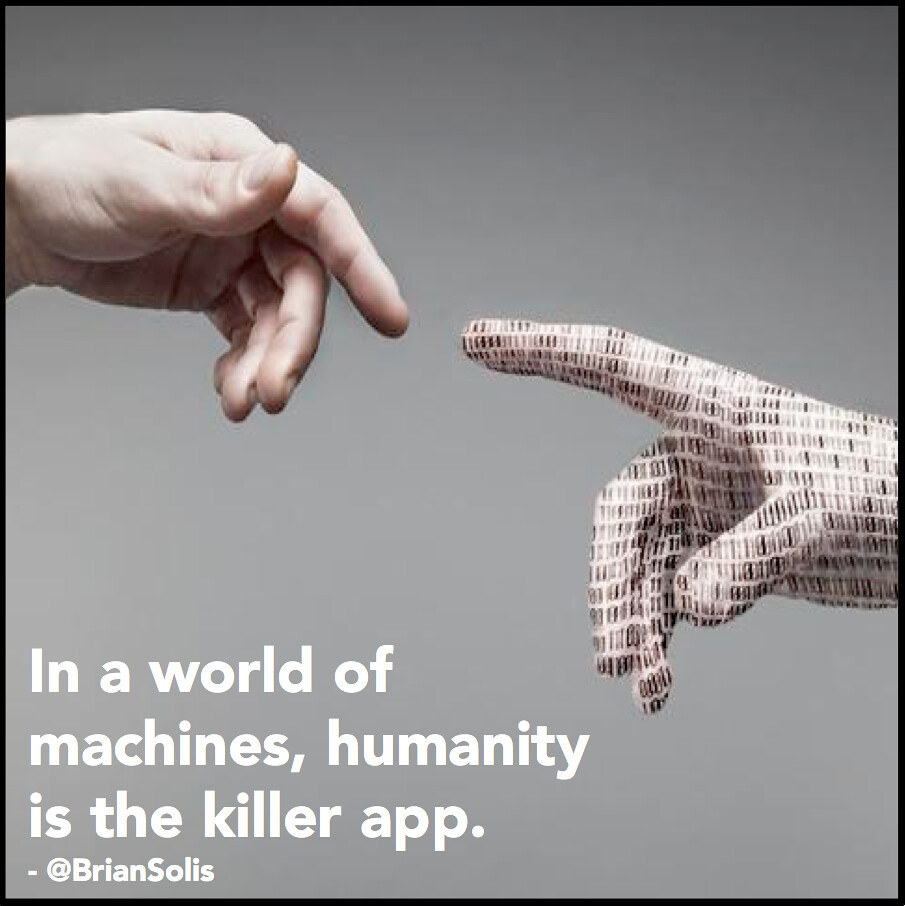
I tend to think in stories and the best ones inhabit me, so as I learn more about the digital humanities—like the fish gaining heightened awareness about the water in which he swims—one story resonates. In “Men areDifferent,” Alan Bloch (1963) writes about a robot archeologist—an android indistinguishable from humans—who tells about the shared history of robots and humans and then describes his trip to a faraway planet where he encountered a man, the last one in the universe. This lonely man “had forgotten how to talk” but with time, the robot and the man learned to communicate. One day the man complained of heat so the robot, inferring that the man’s thermostats were faulty, turned him off by piercing his neck—the same method used to switch off a robot—but alas, he could not get him “running” again. Soon this last man weathered away to bones. A classic science fiction foreboding, elements in Bloch’s tale align with my expanding knowledge and experience of the digital humanities and, as an educator, studying this field awakens within me an urgency for ongoing education, new literacies, and collaboration to foster a more humanistic future for our society. As MIT Scholars Burdick, et al, (2012) ask, what does it mean to be a human being in the networked information age? (p. vii). We had better find out.

Although written in the 1960s, Bloch’s story echoes our current digital reality. Almost everyone on Earth (myself included) is in what feels like an benign relationship with a smart device, yet the power dynamics are not reciprocal. For example, corporations like Facebook use us puppet-like as “unpaid labour” (Berry & Fagerjord, 2017, p. 16) as they mine our online practices for consumer trends and patterns. Each ‘like’ is data for them and dopamine for us. How did we end up here? Technology and virtual reality pioneer Jaron Lanier (2011) cautions, “[i]t is time to take stock” (p. 19), time to expose the ways technological tools have evolved (or not) and critically examine their effects on crowd behaviours, finance, research, culture, even spirituality: “the deep meaning of personhood is being reduced by illusions of bits” (Lanier, p. 19-20). Technology is accelerating rapid social change in how we shop, engage with text, communicate, even fall in love. Amidst the knowledge and skills required to navigate this rapid change and their underlying mechanisms, how do we reinforce humanistic pursuits?

Taking stock means assessing our current situation, getting educated, and acting on it in ways that advance epistemology, reasoning, and practices. Although Bloch’s story fancies that technological determinism—powered by artificial intelligence toward a dangerous endgame—is inevitable, our global society can still influence and positively alter our future if we embrace means and methods that seek to enlighten our technological paths and the information it produces. We can continue to simply consume slick technology for convenience, escapism, trolling—whatever ‘feels’ we seek—or we can use these tools to enable an alternative: “we have to think about the digital layers we are laying down now in order to benefit future generations” and address important issues including “global warming… new energy … wars… aging populations …basic business” (Lanier, 2011, p. 36). There is much to understand about the digital underpinnings at play in our technology; Humanities-based literacies will play a significant role worldwide. Burdick, et al (2012), propose that “Digital humanities may well function as a core curriculum for the 21st century” (p. 5), one where we join forces as global stakeholders in advancing fundamental human rights and values. This is critical given our current environment. With something as simple as basic digital citizenship we have leaders tweeting about the size of their nuclear buttons. 

In Bloch’s story the robot-archaeologist acts as an historian yet his worldview is dangerously one-sided. By nature, archeology requires digging. Digital humanities provide a means to ‘dig’ into Lanier’s “layers” and “structures” inherent in both the sciences and the humanities. Rosenbloom (2012) highlights a need for “a form of methodological pluralism in which multiple methods may be necessary to increase our understanding of individual domains” (p. 223). This requires a new collaboration between the humanities and the sciences, a return to a basic founding principle of the digital Information Age: “[the Internet itself] provided a new model of how people could communicate with each other, [and] changed the nature of collaboration” (Lenier, et al, 1997, p. 7). Digital Humanities scholars, Berry & Fagerjord (2017) also emphasize renewed and new forms of collaboration to facilitate “both the ‘hack’ aspect of knowing how to use computers in humanities scholarship, and the ‘yack’ aspect of knowing how to think about what it is we are doing” (p. 1). Lanier (2010) likewise illustrates the associated negative outcomes of a lack of collective, thoughtful reflection on how to use technology nobly: “I fear we are beginning to design ourselves to suit digital models of us, and I worry about a leaching of empathy and humanity in the process” (p. 39).

Bloch’s robot-archeologist, certainly lacked the necessary empathy and humanity, thus the tragic outcome. The story evokes the discord between “machine” and mankind, what Rosenbloom (2012) refers to as the “uneasy relationship between science and the humanities” (p. 220). If Bloch’s robot represents science, and pathos for the last man represents the absence of humanities, Bloch’s climax implies that we must better understand our technological tools and their impact or, through ignorance and entropy, aid our downfall. It is necessary to infuse a humanistic worldview in our approach to technology or like the fate of Bloch’s last man see our values “weather away.” But how? Through education and new literacies that combine the sciences and the humanities and through shared goals. Without it, we will remain like intellectuals feasting at a dinner party, armed with only perfunctory knowledge about our food’s origins and thus continue take our feast for granted.

In Bloch’s story the robot and the man had to learn to communicate with each other. Assuming mankind created the robot, how did they lose a common language? At some historical point, one might hypothesize they evolved to form differing networks. Using his treatise on our networked society in the Information Age, Castells (2000) might also propose that one network had switched off another it deemed no-longer compatible (p. 22). Castells (2000) notes that “there is little chance of social change within a given network” (p. 22) except “to challenge the network from the outside and in fact destroy it by building an alternative network around alternative values” (p. 16). Indeed. This is key to our current story too. If we develop an alternative network founded on technical literacy combined with humanities principles—such as wisdom, philosophy, reasoning—we can foster a new discourse, one founded in critical thinking intent on using powerful technological tools for greater social stewardship: “Digital_Humanities…envisages the present era as one of exceptional promise for the renewal of humanistic scholarship and sets out to demonstrate the contributions of contemporary humanities scholarship to new modes of knowledge formation enabled by networked, digital environments.” (Burdick, et al, 2012, p. 7).

Like Bloch’s story reveals, there is a current need to reflect on unequal power dynamics and expose/examine the “switchers or power-holders in our society (…connections between media and politics, financial markets and technology, science and the military, and drug traffic and global finance through money laundering)” (Castells, 2000, p. 16). In doing so, we can expose this “human-made automaton” (Castells, 2000, p. 17) global network currently shaping our society rather than the other way around. As Lanier (2010) states, “someone who has been immersed in [our current] orthodoxy [like a fish unaware of the water] needs to experience a figure-ground reversal in order to gain perspective” (p. 23). I am most interested in Lanier’s (2010) “alternative mental environment” (p. 26), with diverse perspectives not composed of a mass of “people who are no longer acting like individuals” (p. xiii). Digital humanities provide new ways to reflect on technology, media, text, research, our values, our future. As an educator dedicated to advancing learning, I recognize at the core of Bloch’s story the breakdown that enables a technological dystopia: ignorance, sustained by apathy or exploited by greed. I doubt Bloch’s notion of our bleak future; however, without education and new literacies—without the combined ‘hack’ and ‘yack,’ we may not even recognize what is human, if we are all thinking like Bloch’s robot. 

References
Berry, D. & Fagerjord, A. (2017) On the way to computational thinking. In Digital Humanities: Knowledge and Critique in a Digital Age. Malden, MA: Polity. 1, 16.

Bloch, A. (1963). Men are Different. In Fifty Short Science Fiction Tales. Asimov, I. & Conklin, G. (Eds.) Collier Books. USA. Retrieved from http://www.gdhsenglish.com/thompson/assets/pdfs/ENG3U1%20pdf's/Short%20Stories/Men%20Are%20Different.pdf

Burdick, A., Drucker, J., Lunenfeld, P., Presner, T. & Schnapp, J. (2012). Digital_Humanities. Massachusetts Institute of Technology. MIT Press. Cambridge, MA. vii, 5, 7.

Castells, M. (2000). Materials for an exploratory theory of the network society. British Journal of Sociology. Vol. No. 51 Issue No. 1. London School of Economics 2000. 16, 17, 22.

Lanier, J. (2010). You are not a Gadget. Vintage Books. New York, NY. xiii, 19-20, 23, 26, 36, 39.

Lenier, B.M., et al. (1997). Brief History of the Internet. Internet Society. 7. Retrieved from https://www.internetsociety.org/internet/history-internet/brief-history-internet/

Rosenbloom, P. (2012). Toward a Conceptual Framework for the Digital Humanities. In Digitial Humanities Quarterly, 6 (2). 220, 223. Retrieved from http://ict.usc.edu/pubs/Towards%20a%20Conceptual%20Framework%20for%20Digital%20Humanities.pdf

Sunday, December 31, 2017

Lang May Yer Lum Reek.

The fireplace in The Great Hall at Edinburgh Castle, Scotland. 
We just watched fireworks in Northern Alberta. And it's -30 C! Two parts impressive and one part yikes. Various New Years Eve celebrations were scaled back or cancelled all across Canada this year. I also read that Scotland's weather interfered with Hogmanay. Yet, thankfully, good people all over the world find a way to celebrate all things hopeful. As they say in Scotland (definitely missing you right now), Lang may yer lum reek.

Saturday, October 14, 2017

Things that deserve the stink-eye:

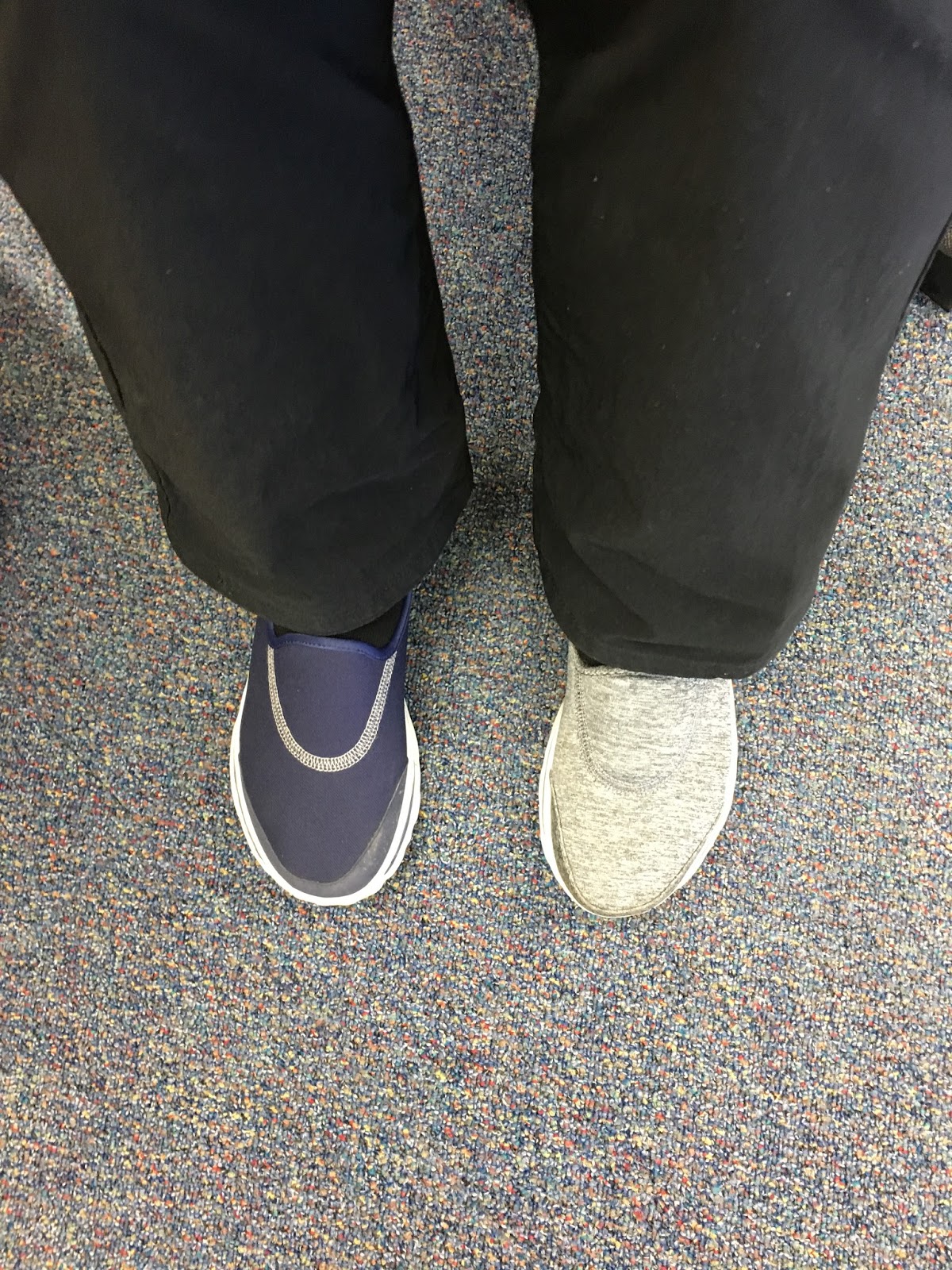
A few days ago, I went to a team meeting away from my regular work-site and discovered when I arrived that I was wearing two different shoes. One gray. One black. One with a thicker heel than the other. Um....

What can you do but laugh? (I've actually done this before.) So I showed everyone at my meeting and we laughed and laughed. Did I mention I'm one of the older ones on our team? I really enjoy working with those toddlers though, so no big whoop.

Then...I texted my wife a photo and she laughed too.

Returning to work the following day, I made an usual discovery...first one co-worker...then another....then another...then another....

My sneaky wife! I felt a simultaneous aching sheepishness and utter love for those charming buggers I work with. What's better than that?


Sunday, September 10, 2017

Things one should never outgrow:

Sometimes I recall so clearly the pull of lakes and rivers from my youth.

Looking into water is like that suspension of disbelief that occurs while watching a good film.

I have read that seeing water triggers our overstimulated brains to rest, and that swimming resets our circadian rhythms and restores healthy sleep patterns.

Water rages in many parts of the world today, but I am hoping that soon there is a rippling stream or a lake or even a pond in your life, some simple calm, some reflection.

Whether within it or not, water immerses us.

Thursday, August 17, 2017

A Good Look

The Firth of Forth, out toward the North Sea,
North Berwick, Scotland


My wife and I spent ten days in Scotland this summer (and one weekend in London). What a dream.

I kept a journal. But first, why Scotland? Our anniversary gift to each other. And my heritage. On both sides. Some of my earliest memories are of visiting my maternal great-grandparents in Saskatoon. I couldn't decipher the content of their discussions due to their Scottish accents but they fascinated me. And we ate toast with tea. I always thought they looked a little pissed off and they seemed to be arguing much of the time. While visiting the Edinburgh Fringe comedy festival, a comedienne explained Glasgow face: bitter, brows down accompanied by a gruff voice (translated as 'appy to see yer).  Lightbulb.

Back to the journal. Giddy, with some highlights:

  • Scottish breakfasts are massive and amazing, odes to protein, haggis included.
  • deep fried fish and chips and mushy peas
  • respect for diversity in art and architecture and urban development, and seriously the best Indian food I've ever eaten
  • a pop-up library in Glasgow
  • Thrift store charity shops all over the UK
  • once locals determined we are Canadian they immediately began to trash-talk Trump, "why would they elect that vile, vile man?" Good question. Perhaps the only redeeming thing about Trump: he helps bring people together, bonded in confusion and distaste. 
  • taking the train through the highlands, all the waterfalls and rusty-red deer, very Harry Potter
  • the Scottish flag painted on a rock high above Ft. William
  • pipers on many street corners
  • Inverlochy castle
  • Arthur's Seat
  • Crabbie's Ginger Beer
  • JK Rowling's old writing spot, The Elephant Room (apple pie and scotch)
  • everything about North Berwick: the beach, Mary Brown, the Lobster Shack, cemetery stories, scones with butter and jam
  • climbing the Scott monument
  • the closes along the Royal Mile
  • finding the home where my great-grandmother and her siblings spent family time together
  • Grassmarket in Edinburgh, and the dungeons at Edinburgh castle
  • rain and cool weather
  • the statue of Winston Churchill in Parliament Square and taking a boat down The Thames
  • our airbnb neighbourhood, Islington, London where we had a salted caramel & popcorn milkshake with a shot of whiskey at the Screen on the Green while watching Dunkirk.


All of it, beauty. I must say, it is most pleasing to have a good look at the world. 

Sunday, July 23, 2017

Full Cup

We've all had the is-the-cup-half-full conversation. I've been thinking a lot about this debate lately, and the people in my life whose perspectives have greatly influenced mine. Sadly, one man whose point of view always pointed me toward realism will now be missing from my life much, much too soon. Dear friends: I urge you not to surround yourself with people who agree with you all the time. Like the saying goes, if everyone in the room is thinking the same way, then no one is thinking. We only grow through challenges.

Despite the unfair loss of his voice, I seek to remain optimistic and hopeful, yet, thanks to him, realistic too. Because, let's be honest, the cup may only be half full of water but it's also half full of air. If you ask me, that's a full cup.